Enterprise SONiC Administration Course

About Course
Open Networking Runs on SONiC. Now You Can Too.
The world’s largest clouds already run on it. AI clusters are being built on it. And enterprises are moving fast to follow. SONiC is redefining how modern networks are built and operated: open, Linux-based, and free from vendor lock-in.
This course turns you into the engineer who can deploy it, automate it and troubleshoot it in production.
The Shift Is Already Happening
- $8B+ – projected SONiC data center switching market by 2027 (IDC, 650 Group)
- 10–20% – expected share of the switch market from enterprise and Tier-2/3 adoption by 2028
- 12,000+ – data centers running open-networking switches, many powered by SONiC
The demand is real. The talent pool is not, yet.
From Bare Metal to Production Fabric
Built around Enterprise SONiC Distribution by Broadcom, this course takes you through the full lifecycle of a SONiC network. Clear, structured lessons are paired with real configurations, real show commands and proven design patterns, so you understand both why it works and how to make it work.
Deploy
Install SONiC with ONIE, boot and manage the switch, secure user access and roll out devices at scale with Zero Touch Provisioning. Understand the architecture under the hood: Linux, containers, Redis and the Management Framework.
Configure
Command the Klish CLI with transactional configuration. Build interfaces, breakouts, port channels, VLANs, and Layer 2 and Layer 3 designs that just work.
Make It Resilient
Engineer high availability with STP, MC-LAG, VRRP and Static Anycast Gateway, then put it all together in a real-world redundant gateway design.
Route at Scale
Run BGP, OSPF and OSPFv3. Control the routing table, cut convergence time with BFD and extend services with DHCP Relay.
Automate Everything
Treat your network as code. Push and pull configuration with Ansible, RESTCONF with YANG models, and gNMI.
Build the Fabric
Design VXLAN/EVPN overlays with Layer 2 and Layer 3 VPNs, EVPN multihoming, symmetric and asymmetric IRB, and multisite Data Center Interconnect.
Own the Campus
Bring SONiC to the edge with PoE, LLDP-MED, 802.1X and MAB, DHCP Snooping, Port Security and ACLs, including control-plane protection.
Troubleshoot Like a Pro
Find the problem before your users do. Master counters, telemetry, sFlow, packet drop analysis, SPAN/ERSPAN, tcpdump, logging, core dumps and tech support files.
New Edition. Fully Rebuilt.
Updated for the latest Enterprise SONiC releases, with new content on OSPFv3, gNMI, booting and system management, advanced debugging, flow-based mirroring, PoE power classes and control-plane ACLs.
Built for Engineers Who Build Networks
- Network engineers moving from proprietary platforms to open networking
- System administrators running Linux-based infrastructure
- Data center and campus architects designing the next generation of networks
Recommended: a working knowledge of switching, IP addressing and routing fundamentals.
Taught by Someone Who’s Done It
Volker Scheel brings more than 28 years of network engineering experience, including two decades at AT&T Global Network Services and eight years at STORDIS. With more than 1,600 engineers trained on SONiC, he knows exactly where people get stuck and how to get them through it.
The Future of Networking Is Open
Enroll now and lead it.
Course Content
Module 1 – Introduction to SONiC
-
00:50
-
03:41
-
08:33
-
08:23
-
00:50
-
Exam 1 – SONiC Introduction
Module 2 – Installation & Initial SONiC Setup
Module 3 – Configuration Methods & Interface Configuration
Module 4 – Redundancy Methods at Layer 2 and Layer 3
Module 5 – Routing Protocols in SONiC
Module 6 – Automation in SONiC
Module 7 – Troubleshooting for SONiC
Module 8 – VXLAN and EVPN and DCI
Module 9 – Campus Deployments
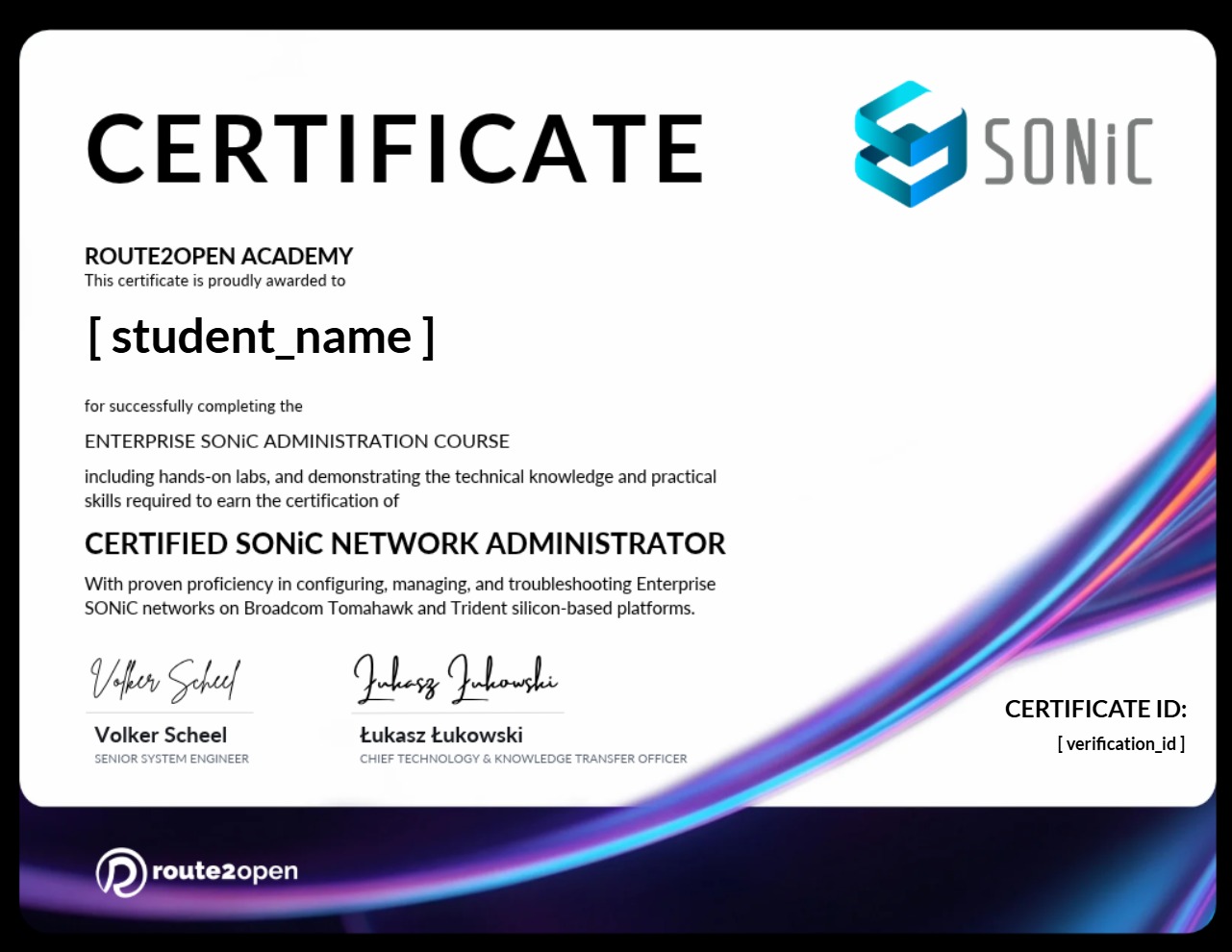
Earn a certificate
Add this certificate to your resume to demonstrate your skills & increase your chances of getting noticed.