

About Course
Why Learn SONiC?
Networking is moving toward open, disaggregated architectures, and SONiC is becoming one of the key operating systems for modern data center networks.
According to 650 Group, SONiC-based data center switching is expected to generate more than $5 billion in revenue in 2026, while enterprise SONiC adoption is forecast to grow by more than 25% year over year through 2027. This growth is driven by hyperscalers, AI infrastructure, cloud providers, and enterprises deploying open networking solutions at scale.
Today’s network engineers are expected to understand far more than basic switch configuration. Modern deployments require practical experience with:
- Leaf-Spine (Clos) architectures
- BGP underlay
- VXLAN EVPN overlays
- Layer 2 and Layer 3 services
- Network automation
- Telemetry and monitoring
- Zero Touch Provisioning (ZTP)
- Production troubleshooting
Our Enterprise SONiC System Administrator Course is designed to build these skills through instructor-led sessions and extensive hands-on labs based on real-world deployment scenarios.
Engineered by Experts. Delivered for Modern Learning.
This course combines real-world engineering expertise with modern AI-powered content delivery.
Every lesson, lab and best practice is built from the experience of Volker Scheel, who has spent 25+ years designing, deploying and operating enterprise networks, including engineering roles at AT&T and STORDIS.
To make the course more engaging, consistent and easier to update as Enterprise SONiC evolves, the lessons are presented using an AI-powered instructor avatar.
The delivery is AI. The expertise is 100% real.
- 25+ years of network engineering experience
- Former Network Engineer at AT&T
- Senior Network Innovation Delivery Engineer at STORDIS
- 2,600+ engineers trained through route2open courses, bootcamps, video courses and Udemy
Course Content
Module 1 – SONiC Introduction (R2O-SON-BRC-SA-R1-M1)
-
AGENDA Module 1
01:29 -
04:01
-
Lesson 2 – Introduction to Containers
03:26 -
Lesson 3 – Introduction to Redis Database
01:57 -
Lesson 4 – What is SONiC General Introduction
04:09 -
Lesson 5 – System Architecture
12:56 -
SONiC Module 1 Summary
00:52 -
Exam 1 – SONiC Introduction (R2O-SON-BRC-SA-R1-M1-E1)
Module 2 – Initial SONiC Setup (R2O-SON-BRC-SA-R1-M2)
Module 3 – Introducing the CLI Interface and Interface Configuration (R2O-SON-BRC-SA-R1-M3)
Module 4 – Redundancy Methods (R2O-SON-BRC-SA-R1-M4)
Module 5 – Routing Protocols in SONiC (R2O-SON-BRC-SA-R1-M5)
Module 6 – Automation in SONiC (R2O-SON-BRC-SA-R1-M6)
Module 7 – Troubleshooting for SONiC ) (R2O-SON-BRC-SA-R1-M7)
Module 8 – VXLAN/EVPN (R2O-SON-BRC-SA-R1-M8)
Module 9 – Campus Deployments (R2O-SON-BRC-SA-R1-M9)
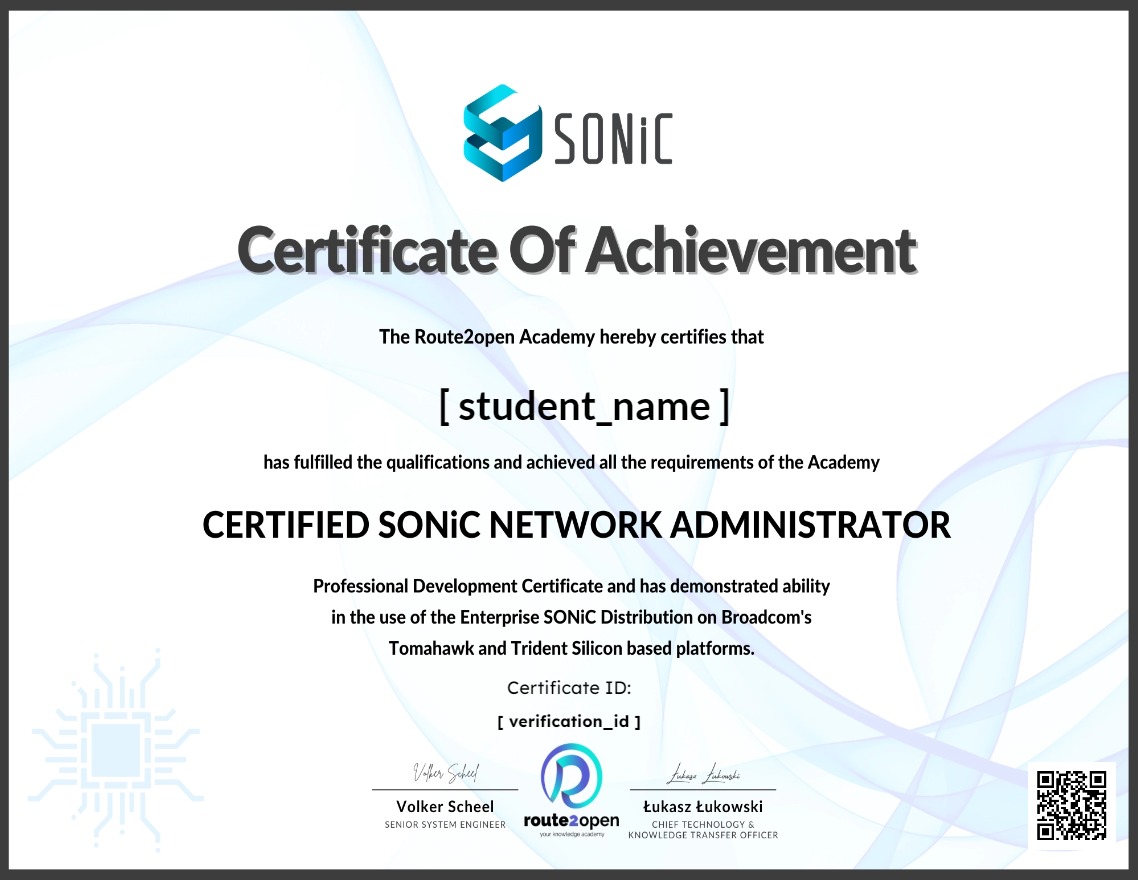
Earn a certificate
Add this certificate to your resume to demonstrate your skills & increase your chances of getting noticed.
Student Ratings & Reviews
- video missing (agenda chapters mostly)
- video totally unavailable on 24-June
- fixed subtitles that cannot be disabled and hovers over crucial parts of slides
- Quizes were forcing incorrect answers such as: " In the OSPF database you see a network LSA for 10.100.20.0/24, and in the BGP table you see an external prefix 10.100.0.0/16. Which route will be used to reach 10.100.20.30, and why? " The correct answer is: /24 the expected is /16 - which is incorrect.